
Don Blazer
Archives:
Stop Coggins Slaughter!
More on EIA
The Latest on EIA
Where Are The EIA Facts?
Breeding
Horse Eyes
Wood Chewing
Safe Trailering
Back Country Horsemen
New Years Resolutions
Horses Legs
Middle Ages
Pony Club
Minature Horses
Saddle Training
Race Horses
Liability
Medications
Brown Jack
Patriotic Horses
Model Horses
Communication
Vaulting
Exercise your Horse
Buying a Horse
Horse Heros
Walter goes Hollywood
Stifles
Flying Horses?
Don't eat like a Pig
Parasites
Back Sore?
Goat Hero
Communication
Foals
History of Horses
Jumping Horses
Lameness and Health
Kick the IRS
Who's Walter?
Books by Don Blazer
View Our Catalog
Secure Book Order Form
Don Blazer
A Horse, Of Course
Secure Book Order Form
Order using our Secure Order Form

Walter (A Horse, of Course) Spills the Oats
Nine Secrets of Perfect Horsemanship
This is a Secure Web Site
Order using our Secure Order Form
View Our Catalog
This is a Secure Web Site
If you have your eyes wide open, you’ll be able to see that horses, at one
time or another, and sometimes in combination, can have a feather in the
eye, a glass eye, a pig eye, a pop eye, a smoky eye or a walleye.
In addition, they have both monocular and binocular vision. The horse
uses monocular vision to view separate things with each eye at the same
time. These objects are to the side and rear of the horse. Binocular
vision, for the horse, is frontal vision, and when using it the horse
concentrates both eyes on the same object. (To know where a horse is
looking, look at his ears. A horse is looking where his ears are pointing,
whether together or separately.)
The horse can see to the front, the side and the rear. In fact, he has a
field of vision of up to 300 degrees.
But his wide-angle vision may adversely influence his ability to learn or
the level of his intelligence, or both. Large eyes, set well out to the
side of the head have always been considered a mark of quality in the
horse. And while the horse should have large eyes, having the eyes placed
too far to the side may be a handicap--from a learning point of view.
The farther out the eyes are placed on the side of the head, the more the
horse must concentrate to achieve frontal vision. Distractions limit his
ability to concentrate, which in turn makes him slower to learn, or, as
some might say, less intelligent. On learning ability scales, animals that
have only frontal vision generally rate higher than animals with monocular
vision.
But this is only one of the horse’s vision-related limitations.
We are pretty sure the horse does not see in color. And we know the
retina of the horse’s eye is somewhat flattened rather than curved. This
means objects are quite frequently out of focus. To bring them into focus,
a horse must lower, tilt, or raise his head.
The horse’s eye does not focus well on objects that are closer than four
feet, and when a horse has his head high in the air, he cannot see the
ground in front of him. Because of a special system within his eye, the
corpora nigra which absorbs light rays from above, the horse cannot see
clearly that which is above the level of his eyes.
And while the horse has a wide field of vision, he does have two blind
spots. They are close to his face, directly in front of him; and the width
of his body, directly behind him. These blind spots are the cause of many
problems for both horse and man. (We are usually in one of those spots
when we get bumped by the horse’s head, or kicked by a tiny hoof.)
All the special advantages and limitations of the horse’s vision have a
great deal to do with the way the horse behaves.
Just imagine what a young horse sees the first time he is taken on a trail
ride or to a horse show!
There is the excitement of a strange place, cars, motorcycles, people,
noises and all sorts of unknown objects. Moreover, at any one time there
is always something happening on each side of the horse. In many cases,
the action isn’t in focus, and even if it were, the horse wouldn’t
understand it. To see what is going on in front of him the horse must
concentrate his full attention straight ahead, but how can he do that when
there is so much new and interesting to see on each side of him?
Seeing is certainly disbelieving for the young horse. He must be asking
himself, "How could my partner put me in such an incomprehensible world?"
Can you blame him for being a little flighty?
Most of us do, and consequently try to jerk, spank or force him into being
calm when he is upset.
Such action will not work. Only understanding how the horse sees will
help.
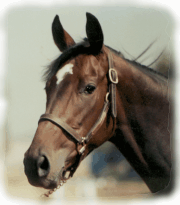
Now take a peek at some other eye-openers. A "feather in his eye" refers
to a visible blemish on the eye. The blemish may be the result of an
injury or a natural defect. In either case, it is considered a fault.
A glass eye lacks color and may be the cause for disqualification by some
breed registries.
A pig eye is a small squinty eye, and a horse that has pig eyes is
generally considered stubborn and hard to handle.
A pop eye is the opposite of pig eye; it is the description given to an
eye that seems to be too large and protruding from the head.
A smoky eye is an eye that is cloudy in color, almost smoke gray.
A walleye is another term for an eye without color and is sometimes
referred to as a China eye.
Each month you'll find a new column on our web site. We hope you'll enjoy it, and maybe
e-mail us with questions or suggestions for other
columns. A Horse, Of Course is a weekly column syndicated
by Success Is Easy. If you like the column, call your local newspaper, or local horse
publication and ask them to subscribe by contacting Success Is Easy, 7119 East Shea Blvd. Suite 109-271, Scottsdale, AZ 85254 |
________________________________
A Horse Of Course |
On-Line Catalog |
Who's Walter?
Courses and Clinics |
Horse Training |
Meet Don Blazer
Ask Don Blazer |
Horses for Sale |
News Flash
Stop Coggins Slaughter! |
Horse Links |
HOME
Info@donblazer.com
Copyright © 2000 by
Don Blazer
Success Is Easy, 13610 N. Scottsdale Rd., Suite 10-406, Scottsdale, AZ 85254
Vanndal Web Designs