
Don Blazer
Archives:
Stop Coggins Slaughter!
More on EIA
The Latest on EIA
ESP
Exercise your Horse
Buying a Horse
Horse Heros
Walter goes Hollywood
Stifles
Flying Horses?
Don't eat like a Pig
Parasites
Back Sore?
Goat Hero
Communication
Foals
History of Horses
Jumping Horses
Lameness and Health
Kick the IRS
Who's Walter?
Books by Don Blazer
View Our Catalog
Secure Book Order Form
Don Blazer
A Horse, Of Course
Secure Book Order Form
Order using our Secure Order Form

Walter (A Horse, of Course) Spills the Oats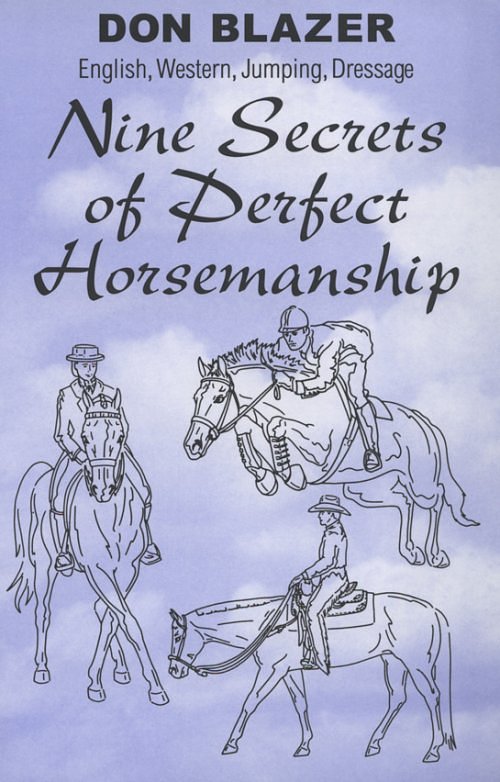
Nine Secrets of Perfect Horsemanship
This is a Secure Web Site
Order using our Secure Order Form
View Our Catalog
This is a Secure Web Site


Twenty-five years ago I predicted vaulting would be a very big sport in
America.
I was wrong.
Vaulting could be described as the art of gymnastics on a moving horse.
It is a big sport in Europe and it is one of the six equestrian disciplines
recognized by the Federation Equestre Internationale (FEI). In America,
however, vaulting is a dinky little sport which never gained the popularity
it should enjoy, and that’s an embarrassment to me.
How can you have something as challenging as gymnastics combined with
something as spectacular as grace on the back of a moving horse that isn’t
the rage all over this country? We’ve got every kind of team sport you can
think of--vaulting can and is a team sport. And we’ve got extreme sports
which require dedicated practice and are dangerous--vaulting is all that
and then some.
I just don’t understand it; unless it’s the fact vaulting sort of requires
a big, fat, wide-backed draft horse. (It’s really hard to do a flag, mill
or scissors on the backbone of an American mustang. That would be similar
to doing gymnastic floor exercises on the balance beam.)
Vaulting, according to the American Vaulting Association (AVA), has a
history dating back to the Roman Empire when it was a means by which
soldiers were trained to ride. During the middle ages, knights practiced
vaulting as a practical way of improving their balance and timing.
Vaulting got its formal start as a competition in Germany. Competitions
are now held worldwide, and quite naturally Germany has the most active
vaulters, about 60,000, says Vicki Smith, AVA national office manager.
The US has about 900 active vaulters participating in competition, Smith
reports.
Vaulters are judged on both a set of compulsory moves, and in free style
competition called a "kur."
The big, fat draft horse is longed in a circle, and the first real test
for a vaulter is to run along side the moving horse, and then to vault onto
the horse’s back. Not being able to do that, I was also not able to
perform the basic seat, the flag or the stand, all of which are considered
to be "static" exercises. Each of the static exercises is held for four
canter strides. The other four compulsories, not being static, are, of
course, much more dynamic. The vault on is exciting, while the mill, the
scissors and the flank (dismount) can be pretty flashy.
Vaulters usually learn their exercises and warm-up drills on a practice
barrel, which is sort of like riding a mechanical bull. The barrel allows
the beginning vaulter to learn competition-required exercises at the very
steady gait of a standstill.
While the beginning vaulter is learning, so is the horse. You want a
horse with a very good disposition. The horse must be taught to work a
longe line upon voice command and maintain a smooth, steady pace. When
horse and rider have the basics under control, let the partnership begin.
Vaulting is good for any rider, since as a by-product of the practice,
vaulters gain better body control, more rhythm and timing, and greater
balance and suppleness.
Joni Fitts who has a school of horsemanship in Scottsdale, Arizona, has
started teaching vaulting as a way to improve the talents of both her
English and western riders.
"Vaulting is a wonderful way to keep a young rider’s level of enthusiasm
high, and to teach courage and determination," Joni says.
So now that Joni has four or five new vaulters learning the skills, maybe
vaulting will take off in this country.
International competitions are held annually and the World Vaulting
Championships are held every other year.
And once an American wins the gold, I predict vaulting will become a very
big sport in this country.
Each month you'll find a new column on our web site. We hope you'll enjoy it, and maybe
e-mail us with questions or suggestions for other
columns. A Horse, Of Course is a weekly column syndicated
by Success Is Easy. If you like the column, call your local newspaper, or local horse
publication and ask them to subscribe by contacting Success Is Easy, 13610 N. Scottsdale Rd., Suite 10-406, Scottsdale, AZ 85254 |
________________________________
A Horse Of Course |
On-Line Catalog |
Who's Walter?
Courses and Clinics |
Horse Training |
Meet Don Blazer
Ask Don Blazer |
Horses for Sale |
News Flash
Stop Coggins Slaughter! |
Horse Links |
HOME
Info@donblazer.com
Copyright © 2000 by
Don Blazer
Success Is Easy, 13610 N. Scottsdale Rd., Suite 10-406, Scottsdale, AZ 85254
Vanndal Web Designs