
Don Blazer
Archives:
Stop Coggins Slaughter!
More on EIA
The Latest on EIA
Communication
Vaulting
Exercise your Horse
Buying a Horse
Horse Heros
Walter goes Hollywood
Stifles
Flying Horses?
Don't eat like a Pig
Parasites
Back Sore?
Goat Hero
Communication
Foals
History of Horses
Jumping Horses
Lameness and Health
Kick the IRS
Who's Walter?
Books by Don Blazer
View Our Catalog
Secure Book Order Form
Don Blazer
A Horse, Of Course
Secure Book Order Form
Order using our Secure Order Form

Walter (A Horse, of Course) Spills the Oats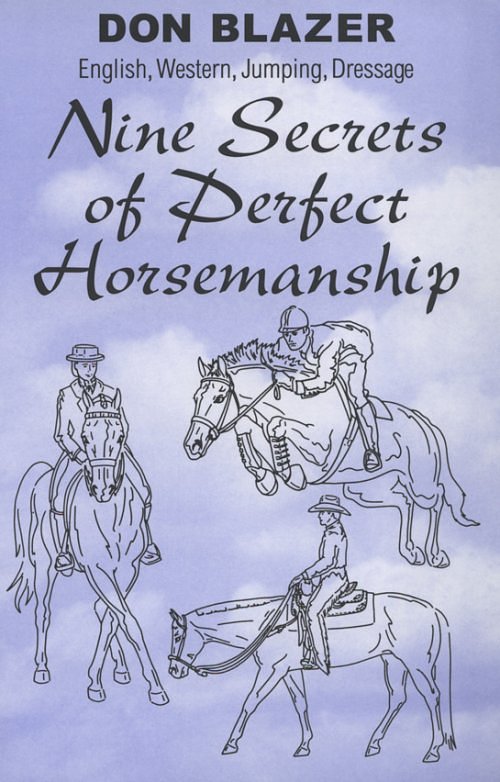
Nine Secrets of Perfect Horsemanship
This is a Secure Web Site
Order using our Secure Order Form
View Our Catalog
This is a Secure Web Site
I peeked into Walter’s stall, just out of curiosity. There was a lot of movement going on in there.
Walter, a horse, of course, had his day sheet over his ears and twisted around and draped across his right shoulder. He was looking at himself in a mirror and striking different poses. He grabbed the sheet in his mouth and flipped it back so it slid down his neck. Then grabbing the fabric at his chest, he pulled the sheet up his chest. He looked at himself, but appeared unsatisfied.
"What’s going on?" I asked.
He looked a little embarrassed, then replied, "I’m trying to create a new
fashion look," he said.
"Why?"
"Because I’m soon going to be on the runway with Naomi, Christy, and
Cybil," he said. "I’m going to be a model."
"What makes you think you’re going to be a fashion model?’
"Sheryl was here yesterday, measuring me from head to toe, putting tape
all over me, and taking pictures of me walking, trotting and loping. I’m
sure the sewing machines are whizzing; the fall Paris shows aren’t far
off." He obviously had it all figured out--wrong again.
"You can forget Naomi and Christy. You’re going to be a model, but not
that kind."
"Well, what kind?"
"A Hartland Collectible," I explained. "You’re being reproduced as a nine
by 14-inch resin model. Being resin instead of plastic, they can capture
even the wrinkles in your nose."
"I’m wrinkleless," Walter said emphatically.
"You’re ridiculous," I countered.
I explained to Walter that Sheryl Leisure, a designer for Hartland, took
the photos so she could see how his muscles appeared when he was in motion.
The tape she placed in strategic places so she could keep his body
proportions correct. From the photos, Sheryl will make sketches of Walter
in different poses, then select the pose for the model. (Here’s a secret I
didn’t even tell Walter: he’ll be trotting.)
Sheryl then turns the sketches into a clay figure. She uses a wire base,
packing clay around it, and then she sculpts Walter. Once she gets the
figure she wants, the first resin casting is made. From this casting she
will produce about six figures. These figures are her working models. She
will make proportion and detail changes and then polish to perfection.
When she gets exactly what she wants, the master mold is cast.
Model horses and model horse collecting has been around since the early
1950s, Sheryl explains. Hartland Collectibles, known as a figure
maker--sports, religious and horse--was among the first to produce a series
of horses. The hobby of collecting various models really exploded when
Breyer began the large-scale production of realistically-colored tenite
horse sculptures in the late 50s and early 1960s.
As naturally happens when horse lovers get together, there started to be
comparisons between models, markings and poses. Model horse shows began.
In the 1970s model admirers started formalized "live shows" where
professional judges were engaged, prizes were awarded and records kept of
the competition results. Today model horse collecting and competition is
worldwide. There are several annual model horse festivals sponsored by
Breyer, The Peter Stone Co., and Hartland Collectibles, and each year there
are special model runs and limited editions offered.
While Breyer, Stone and Hartland are the major model producers, there are
numerous companies which offer horse sculptures in different materials,
such as porcelain. And the customizing of models by highly talented
artists is becoming very popular. The trading of models has developed into
another facet of the hobby, and web sites for displaying, selling,
customizing and chatting about models attract new fans.
Of course all this popularity spawed expanded competition and now there
are riders for the models, and tack, including leg wraps, saddles, bridles,
splint boots, blankets, hoods and tail wraps.
"So, you are going to be part of a whole culture craze, Walter. How’s
that grab you?"
"I’m thinking models in city parks. You know, next to the statues of
famous generals, like Napoleon, Washington and Robert E Lee."
To Learn More About Walter Visit the
Who's Walter? Web Page
Each month you'll find a new column on our web site. We hope you'll enjoy it, and maybe
e-mail us with questions or suggestions for other
columns. A Horse, Of Course is a weekly column syndicated
by Success Is Easy. If you like the column, call your local newspaper, or local horse
publication and ask them to subscribe by contacting Success Is Easy, 13610 N. Scottsdale Rd., Suite 10-406, Scottsdale, AZ 85254 |

________________________________
A Horse Of Course |
On-Line Catalog |
Who's Walter?
Courses and Clinics |
Horse Training |
Meet Don Blazer
Ask Don Blazer |
Horses for Sale |
News Flash
Stop Coggins Slaughter! |
Horse Links |
HOME
Info@donblazer.com
Copyright © 2000 by
Don Blazer
Success Is Easy, 13610 N. Scottsdale Rd., Suite 10-406, Scottsdale, AZ 85254
Vanndal Web Designs