
Don Blazer
Archives:
Stop Coggins Slaughter!
More on EIA
The Latest on EIA
Where Are The EIA Facts?
Liability
Medications
Brown Jack
Patriotic Horses
Model Horses
Communication
Vaulting
Exercise your Horse
Buying a Horse
Horse Heros
Walter goes Hollywood
Stifles
Flying Horses?
Don't eat like a Pig
Parasites
Back Sore?
Goat Hero
Communication
Foals
History of Horses
Jumping Horses
Lameness and Health
Kick the IRS
Who's Walter?
Books by Don Blazer
View Our Catalog
Secure Book Order Form
Don Blazer
A Horse, Of Course
Secure Book Order Form
Order using our Secure Order Form

Walter (A Horse, of Course) Spills the Oats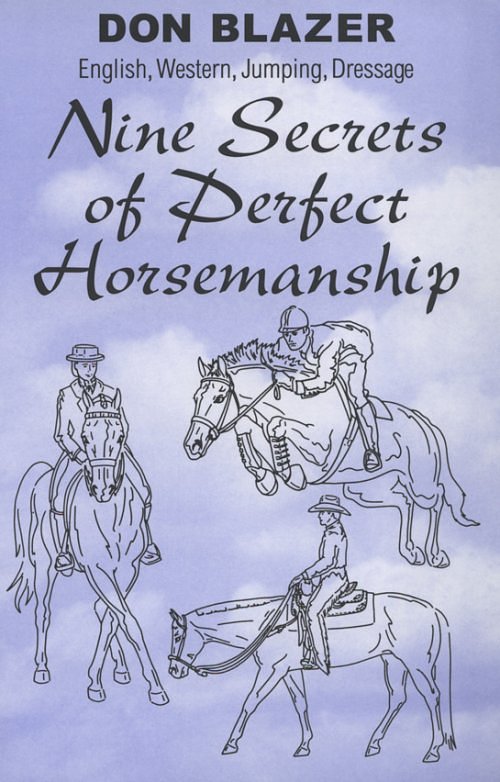
Nine Secrets of Perfect Horsemanship
This is a Secure Web Site
Order using our Secure Order Form
View Our Catalog
This is a Secure Web Site


I’ve always been an advocate of saddle training horses at a young age. It
has always gotten me into trouble---not with horses, with people.
What I’m about to say will probably generate a lot more criticism.
I like to saddle break (I use the word "break" just to needle those who
are already furious with me) using horses when they are one-year-old.
I like to saddle break race horses from age 15-months to 18-months.
Now I’ve heard all the arguments against early saddle training. "Horses
shouldn’t be racing as two year olds. You can’t start a jumper before he’s
four. Never saddle break a horse until he’s at least three years old. All
you do, starting them young, is break them down."
Horse feathers! It just ain’t true!
And if you don’t like what I just said, find some scientific evidence to
support the false notion early saddle training breaks horses down.
What breaks young horses down is man’s ego. Pushing too hard, asking for
too much, demanding they work beyond their conditioning, that’s what breaks
young horses down.
I’ve trained show horses and I’ve trained race horses, and I understand
competition. I understand there are going to be injuries. It goes with
any kind of sport. It’s part of the deal.
But it’s not the early training which is at fault. In fact, early
training may be keeping horses from breaking down.
You’ve heard this before--no hoof, no horse. Studies on the relationship
of foot imbalance to lameness conclude that up to 95 per cent of all horses
have some form of foot imbalance which predisposes them to injury. Most
are musculoskeletal disorders.
Don’t blame those injuries on training at a young age.
According to Gail Williams BA (Hons) PhD and Martin Deacon FWCF, authors
of No Foot, No Horse, about 70 per cent of all sport horses will sustain at
least one musculoskeletal disorder in any one season. Of those injuries,
75 per cent are caused or contributed to by hoof imbalances.
That doesn’t leave very many injuries to be blamed on early training.
According to Craig Bailey and colleagues from the University of Sydney, as
reported in The Horse magazine, January 2001, horses having their first
race during their 2-year-old season had longer racing careers than horses
first racing at three years or older. Why? It can’t yet be determined,
say the researchers.
The researchers should ask some old horsemen, who have known for years
that planned, controlled stresses are required to make young horses strong
and ready for competition. Horses which work early, are stronger later in
life. It takes stress to the muscle system to develop strong muscles. It
takes stress to the skeletal system to encourage bone to remodel and become
more dense where density is needed. It takes stress to the mental system
to generate calmness in horses.
Great trainers, or conditioners if you will, have always advocated
starting horses at a young age. Start them slowly, increase exercise
slowly, increase stress slowly.
I’ve been advised, and I pass it along to you, never allow a young horse’s
training to get him hot, physically or mentally. The advice keeps the
trainer from breaking the horse down.
I’ve started 12-month-old horses under saddle with no ill effects by
taking a week to introduce them to their equipment, a week to get on them,
and a week to walk them around. They don’t panic, they don’t buck, they
don’t get hurt. Then they get a few months off with no riding. At
15-months of age they get saddled and ridden off without trauma or
fretting. (Each horse is an individual, and the physical attributes of
each must be taken into consideration. There is no hard and fast rule
which applies to all horses at all times.) Of course, how soon the horse
starts trotting or cantering is a matter to be decided as his training
progresses.
Push the young horse too hard, and he’ll get hurt.
Don’t push the young horse--or the older horse for that matter--and they
don’t develop, becoming stronger and less subject to injury.
Not saddle training a horse doesn’t help him in the least. In fact, some
older horses may have less muscle strength in relationship to body mass
than a young horse. This often does hurt them when training finally
starts.
According to Bailey, "on-going studies of the effects of training on the
body at a very young age indicate that we should be training horses before
the skeleton is fully mature."
Saddle train them early, and keep their feet balanced, if you love your
horse. Yell at me later.
Each month you'll find a new column on our web site. We hope you'll enjoy it, and maybe
e-mail us with questions or suggestions for other
columns. A Horse, Of Course is a weekly column syndicated
by Success Is Easy. If you like the column, call your local newspaper, or local horse
publication and ask them to subscribe by contacting Success Is Easy, 13610 N. Scottsdale Rd., Suite 10-406, Scottsdale, AZ 85254 |
________________________________
A Horse Of Course |
On-Line Catalog |
Who's Walter?
Courses and Clinics |
Horse Training |
Meet Don Blazer
Ask Don Blazer |
Horses for Sale |
News Flash
Stop Coggins Slaughter! |
Horse Links |
HOME
Info@donblazer.com
Copyright © 2000 by
Don Blazer
Success Is Easy, 13610 N. Scottsdale Rd., Suite 10-406, Scottsdale, AZ 85254
Vanndal Web Designs