
Don Blazer
Archives:
Stop Coggins Slaughter!
More on EIA
The Latest on EIA
Where Are The EIA Facts?
Pony Club
Minature Horses
Saddle Training
Race Horses
Liability
Medications
Brown Jack
Patriotic Horses
Model Horses
Communication
Vaulting
Exercise your Horse
Buying a Horse
Horse Heros
Walter goes Hollywood
Stifles
Flying Horses?
Don't eat like a Pig
Parasites
Back Sore?
Goat Hero
Communication
Foals
History of Horses
Jumping Horses
Lameness and Health
Kick the IRS
Who's Walter?
Books by Don Blazer
View Our Catalog
Secure Book Order Form
Don Blazer
A Horse, Of Course
Secure Book Order Form
Order using our Secure Order Form

Walter (A Horse, of Course) Spills the Oats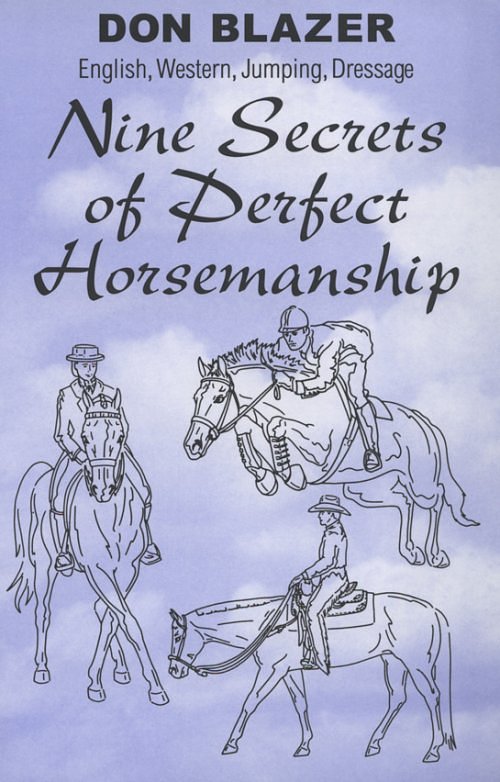
Nine Secrets of Perfect Horsemanship
This is a Secure Web Site
Order using our Secure Order Form
View Our Catalog
This is a Secure Web Site


"I’m a mini, I’m a mini," Walter, a horse, of course, shouted from his
stall.
"No you’re not," I corrected. "You are a Quarter Horse."
"No, I’m a mini," he insisted, pointing his left foreleg at a resin model
sculpted in the form of Walter. There was pride in his eyes. "I’m a
mini," he said again.
"No," I responded. "You are an American Quarter Horse who just happens to
have an 19-inch model made in your image."
"A mini," I said emphatically and with authority, "is a miniature horse."
"Minis," I informed Walter, "are a recognized breed registered with the
American Miniature Horse Association of Alvarado, Texas."
The American Miniature Horse Association, Inc., was organized in 1978 to
aid and encourage the breeding, use and perpetuation of the American
Miniature Horse. The organization wants to keep the mini separate and
apart from ponies and other small equines.
"And," I said to Walter, "according to the AMHA’s rules and regulations,
an animal exceeding 34 inches in height at the last hairs of his mane at
the withers is not eligible for registration. That leaves you out."
I suggested to Walter there were plenty of myths and misinformation about
the mini, and that most of what we know is founded in logic, supposition
and speculation. Most modern historians and horsemen tend to support the
idea the breed--as most breeds--is a derivative of many sources.
If you examine the evolution of the horse, you know our modern horse of
16-hands is the descendant of a very small, nearly fox-sized equine. So,
somewhere along the line it is not inconceivable that the mini evolved as a
horse, but remained small trying to survive harsh climates and a limited
food supply.
Our knowledge of genetics indicates horses can be bred for size, and
according to the AMHA it is known that at various times minis were bred for
pets, novelty, research, mining work, exhibition and royal gifts.
Of course today, there is no question, they are being bred for monetary
gain. They sell well, and frequently for a whole lot of money.
It is speculated, today’s mini is the result of nearly 400 years of
selective breeding. Of course, that’s speculation.
The association reports the first mention of a small horse being imported
to the United States was in 1888. However, there apparently was not much
public notice of the little guys prior to 1960 when the mini started to
gain some popularity.
It is believed the American Miniature Horse utilized the blood of the
English and Dutch mine horses brought to this country in the 1800s and used
in Appalachian coal mines as late as 1950. The American Miniature Horse,
as documented in the pedigrees of some minis today, also drew upon the
blood of the Shetland pony, according to the AMHA.
When you see a mini, the general impression should be of a small, sound,
well-balanced horse. The mini should have the correct conformational
characteristics required of large horses. You should see refinement and
femininity in mares and boldness and masculinity in stallions.
The association says you should see symmetry, strength, agility and
alertness, and that preference in judging should be given to the smaller
horse, other characteristics being equal. After all, the AMHA says, the
objective is to breed the smallest possible perfect horse.
What do a mini do?
They show at halter, pull carts and go over jumps while on a longe line.
And, Walter, a mini can be mini in other ways. For example, the costs of
stabling a mini range from $50 to $150 per month, whereas, for you, it can
cost from $200 to $600 per month.
And the cost of feeding a mini is about $25 per month.
"The cost of feeding you, my friend, is about $150 per month. So, you
see, you are not a mini, never where a mini and never will be a mini."
As I walked away, Walter was looking at his model with a contented grin.
"It’s a mini-me!"
"I heard that."
Each month you'll find a new column on our web site. We hope you'll enjoy it, and maybe
e-mail us with questions or suggestions for other
columns. A Horse, Of Course is a weekly column syndicated
by Success Is Easy. If you like the column, call your local newspaper, or local horse
publication and ask them to subscribe by contacting Success Is Easy, 13610 N. Scottsdale Rd., Suite 10-406, Scottsdale, AZ 85254 |
________________________________
A Horse Of Course |
On-Line Catalog |
Who's Walter?
Courses and Clinics |
Horse Training |
Meet Don Blazer
Ask Don Blazer |
Horses for Sale |
News Flash
Stop Coggins Slaughter! |
Horse Links |
HOME
Info@donblazer.com
Copyright © 2000 by
Don Blazer
Success Is Easy, 13610 N. Scottsdale Rd., Suite 10-406, Scottsdale, AZ 85254
Vanndal Web Designs