
Don Blazer
Archives:
Stop Coggins Slaughter!
More on EIA
The Latest on EIA
Where Are The EIA Facts?
Horses Legs
Middle Ages
Pony Club
Minature Horses
Saddle Training
Race Horses
Liability
Medications
Brown Jack
Patriotic Horses
Model Horses
Communication
Vaulting
Exercise your Horse
Buying a Horse
Horse Heros
Walter goes Hollywood
Stifles
Flying Horses?
Don't eat like a Pig
Parasites
Back Sore?
Goat Hero
Communication
Foals
History of Horses
Jumping Horses
Lameness and Health
Kick the IRS
Who's Walter?
Books by Don Blazer
View Our Catalog
Secure Book Order Form
Don Blazer
A Horse, Of Course
Secure Book Order Form
Order using our Secure Order Form

Walter (A Horse, of Course) Spills the Oats
Nine Secrets of Perfect Horsemanship
This is a Secure Web Site
Order using our Secure Order Form
View Our Catalog
This is a Secure Web Site

We’re bashing, battering and breaking our horse’s knees.
You can blame some of it on our selective breeding, and you can blame
the rest of it on our insane desire to have horses use their front ends for
slowing forward speed or stopping.
It’s all the rage.
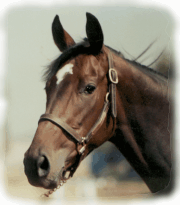
A horse’s knee can be compared to a human’s wrist. It’s comprised of
two rows of four bones each. Actually the horse’s knee joint is three joints.
The radius makes a joint with the upper row of knee bones; the upper row makes a
joint with the lower row; and the lower row joins with the cannon bone.
The knee is a complex system, and therefore presents plenty of
opportunity for trouble.
The horse’s knee was meant to flex, and normally should be able to be
bent easily so the bottom of the horse’s hoof touches the horse’s elbow. Such
flexion should cause no distress.
The knee was designed to bend only one way. When it is bent the wrong
way, inverted toward the rear of the horse, damage occurs. Unfortunately, such
inversion takes place frequently among performance horses, especially when they
are being asked to slow down by a rider pulling back on the reins.
When a rider pulls on the reins to stop a horse, the horse is virtually
forced to use his front legs as brakes. The knees are bent backwards when the
horse tries to stop his mass with his front legs instead of allowing that mass
to move over the stationary leg. A western slide stop is an exaggeration of how
a horse should use his hindquarters to stop while his front legs keep moving.
The cartilage between the bones of the knee, the joint fluid and the
bones themselves were designed to withstand a certain amount of stress.
However, the stresses of sprint racing, jumping, pole bending, calf roping and
polo--to mention just a few--are a little too great when compounded by a rider
balancing on the horse’s mouth or pulling back on the reins.
The result of consistent excessive stress to both young and old knees
is a squeezing and pinching and deterioration of the cartilage, a leaking of
joint fluid, and a chipping, denting or scratching of bone. All of which leads
to inflammation, then arthritis, and often joint deformities. Once injured, a
knee takes a long time to heal because the knee has a poor blood supply.
And seldom does an injured knee get help as quickly as it should,
because knee injuries are hard to detect in the early stages.
A horse with a knee problem will show a little stiffness in the injured
leg when first brought from a stall, but if you are not looking for it, you
might not see it. The horse, if viewed from the front, will tend to swing the
affected leg outward, eventually putting most of his weight on the inside heel.
But during the early stages, the horse will "warm up" and lose all
symptoms of lameness. Just about the time the rider thinks the horse is a "bit
off," the horse begins to travel fine. The rider goes on with the exercise as
planned, and the sound horse is becoming one with a major knee problem.
Time off from work (not stall rest) is the greatest healer of knee
injuries. There are some drug therapies, but they too require major amounts of
"time off." When drug therapies are used to keep the horse in competition,
there is no healing.
Horses which are "back at the knee" are the most susceptible to knee
problems.
And, of course, today’s competitive pleasure horse--of nearly every
breed--has to move slowly, with no reach by his front legs. What kind of front
legs move slowly with no reach? Front legs, hanging from a straight shoulder,
back at the knees. So we are breeding them that way.
To compound the problem, the desire for excessive slowness is moving
into other areas of competition. Now we have more and more riders cranking the
horse’s head down to force the horse to go slow by braking with his front legs.
We are literally bashing and breaking the horse’s knees.
Of course there is no way to help the horse who’s rider will not learn.
The more the rider hangs and pulls on the horse, the more battered the horse’s
knees.
It’s the "in" thing, man!
Each month you'll find a new column on our web site. We hope you'll enjoy it, and maybe
e-mail us with questions or suggestions for other
columns. A Horse, Of Course is a weekly column syndicated
by Success Is Easy. If you like the column, call your local newspaper, or local horse
publication and ask them to subscribe by contacting Success Is Easy, 13610 N. Scottsdale Rd., Suite 10-406, Scottsdale, AZ 85254 |
________________________________
A Horse Of Course |
On-Line Catalog |
Who's Walter?
Courses and Clinics |
Horse Training |
Meet Don Blazer
Ask Don Blazer |
Horses for Sale |
News Flash
Stop Coggins Slaughter! |
Horse Links |
HOME
Info@donblazer.com
Copyright © 2000 by
Don Blazer
Success Is Easy, 13610 N. Scottsdale Rd., Suite 10-406, Scottsdale, AZ 85254
Vanndal Web Designs