
Don Blazer
Archives:
Stop Coggins Slaughter!
More on EIA
The Latest on EIA
Where Are The EIA Facts?
Horses Legs
Middle Ages
Pony Club
Minature Horses
Saddle Training
Race Horses
Liability
Medications
Brown Jack
Patriotic Horses
Model Horses
Communication
Vaulting
Exercise your Horse
Buying a Horse
Horse Heros
Walter goes Hollywood
Stifles
Flying Horses?
Don't eat like a Pig
Parasites
Back Sore?
Goat Hero
Communication
Foals
History of Horses
Jumping Horses
Lameness and Health
Kick the IRS
Who's Walter?
Books by Don Blazer
View Our Catalog
Secure Book Order Form
Don Blazer
A Horse, Of Course
Secure Book Order Form
Order using our Secure Order Form

Walter (A Horse, of Course) Spills the Oats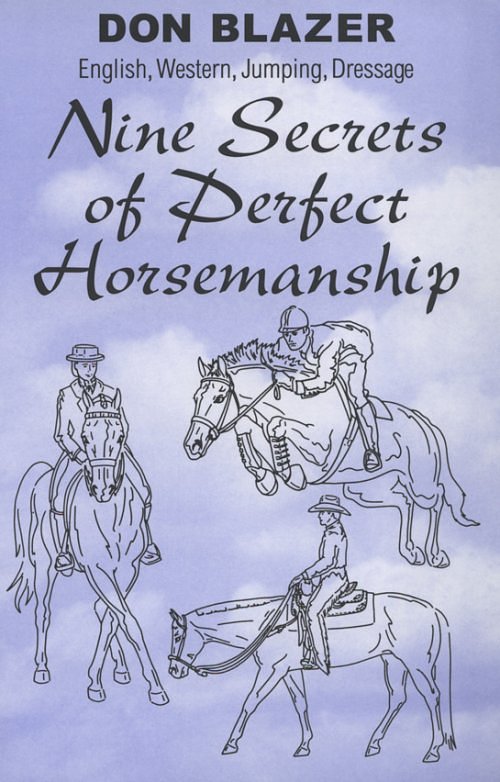
Nine Secrets of Perfect Horsemanship
This is a Secure Web Site
Order using our Secure Order Form
View Our Catalog
This is a Secure Web Site


With the price of gasoline going up, up, up, we may have to give up our
high powered chariots, and go back to riding the horse.
(It was a problem with the chariot which caused us to ride the horse is
the first place.)
About 5,500 years ago man was trying to figure out what to do with
horses and wheels., when va, va voooom, the chariot was invented. By 2000 B.C.
the chariot-culture was zooming along and expanding. It started somewhere
between the Black Sea and the Mediterranean and got as far north as China.
Complete chariots with spoked wheels, full sets of harness, weapons and the
bones of both driver and team were found in the graves of the Shan Dynasty which
dates about 1500 B.C.
Well, just when you think your chariot is rolling along smoothly, you
hit a bump in the road. And that’s exactly what happened.
The age of the chariot lasted a good 3,000 years, but bumps and hills
started to take their toll. Chariots, you see, only operate well on flat
ground. And a log or a ditch play havoc with a chariot ride. (Plus, some smart
general discovered his army could easily defend against chariots by hiding
behind trees or a wall.)
But the biggest problem of all, for the chariot, turned out to be the
crude design of the harness the horse wore.
If the horse had to pull the buggy uphill, the harness slipped up the
horse’s neck and nearly choked him to death. Going downhill the harness
wouldn’t hold the chariot back, and the blasted thing overran the horses.
In order to survive--war was then, as now, the order of the day--man
had to give up the powerless, problem-plagued chariot and start riding astride
the horse.
The horseman came of age about 1000 B.C. Most men with horses became
horsemen instead of chariot drivers because it was simply a better way to
conquer the world.
The first great rider-warriors were the Parthians and Persians who
inflicted crushing defeats on the Romans who were still riding in chariots.
(The Romans finally went to riding astride, but that’s another story.) These
Oriental horsemen were also archers, and because they were, the horse was about
to enter the most significant phase of his history--selective breeding.
Horsemen wearing armor were needed to combat the Oriental riding
archers. And a horseman wearing armor needed a bigger, heavier horse. He also
needed some specialized equipment.
The western world started breeding bigger horses for knights, and the
Asiatic invention of the stirrup was adopted. In addition, saddles were
designed with built-up cantles. Knights threw down their spears and picked up
longer, heavier lances, tucked them under their arms and with the aid of the
stirrup and the high-backed saddle thrust the full force of their horses into
the enemy.
The combination of the heavy horse, high-backed saddles and stirrups is
given credit for winning the Battle of Hastings in 1066.
To win more wars, generals found they needed more than just heavy
horses; they needed horses of all kinds. Selective breeding was the answer.
The Sumpter or Capul was the first horse bred to carry packs, and later
used to pull war wagons.
The Courser became the race horse and was used by speedy messengers.
The Rouncy, on which the knights rode when not in battle, became the
cob, the most generally useful of all types of horse.
And there was the Palfrey of feudal times which developed a "running
walk" and became the western world’s general riding horse for hundreds of years.
As the horse spread around the world, selective breeding did too,
accounting for all the breeds, types and training given to horses right up to
the 1900’s. Just after the turn of the century the automobile began to take
over, and man thought he had his travel and war problems solved.
Ah, but then, history has a way of repeating itself.
Each month you'll find a new column on our web site. We hope you'll enjoy it, and maybe
e-mail us with questions or suggestions for other
columns. A Horse, Of Course is a weekly column syndicated
by Success Is Easy. If you like the column, call your local newspaper, or local horse
publication and ask them to subscribe by contacting Success Is Easy, 13610 N. Scottsdale Rd., Suite 10-406, Scottsdale, AZ 85254 |
________________________________
A Horse Of Course |
On-Line Catalog |
Who's Walter?
Courses and Clinics |
Horse Training |
Meet Don Blazer
Ask Don Blazer |
Horses for Sale |
News Flash
Stop Coggins Slaughter! |
Horse Links |
HOME
Info@donblazer.com
Copyright © 2000 by
Don Blazer
Success Is Easy, 13610 N. Scottsdale Rd., Suite 10-406, Scottsdale, AZ 85254
Vanndal Web Designs