
Don Blazer
Archives:
Stop Coggins Slaughter!
More on EIA
The Latest on EIA
Where Are The EIA Facts?
Back Country Horsemen
New Years Resolutions
Horses Legs
Middle Ages
Pony Club
Minature Horses
Saddle Training
Race Horses
Liability
Medications
Brown Jack
Patriotic Horses
Model Horses
Communication
Vaulting
Exercise your Horse
Buying a Horse
Horse Heros
Walter goes Hollywood
Stifles
Flying Horses?
Don't eat like a Pig
Parasites
Back Sore?
Goat Hero
Communication
Foals
History of Horses
Jumping Horses
Lameness and Health
Kick the IRS
Who's Walter?
Books by Don Blazer
View Our Catalog
Secure Book Order Form
Don Blazer
A Horse, Of Course
Secure Book Order Form
Order using our Secure Order Form

Walter (A Horse, of Course) Spills the Oats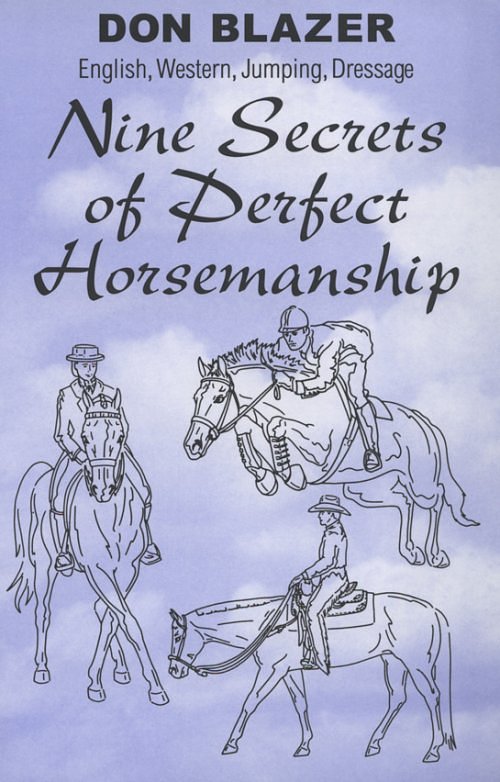
Nine Secrets of Perfect Horsemanship
This is a Secure Web Site
Order using our Secure Order Form
View Our Catalog
This is a Secure Web Site

I’m not much of a back country horseman.
There’s not much back country in Scottsdale, AZ. (When I’m in an arena with
less than five other riders, I think I’m in the wilderness.)
But if I was a back country horseman, I’d want to be a Back Country
Horseman.
A lot of horsemen do a lot of talkin’ about what’s wrong with this and
what’s wrong with that. A lot of horsemen do a lot of complain’ about all
the open riding areas we are losing. Unfortunately, most of the time
they’re talkin’ more than they’re doin’.
But Back Country Horsemen of America (BCH) are talkin’ and doin’, and I’m
impressed with both their talk and their walk.
The organization was formed to do three things: offer volunteer service in
the back country, educate horsemen on minimum impact horse handling and get
involved in land use planning.
"You’d be surprised at how many groups want to restrict the use of horses
in wilderness areas," says Melinda Codling of the Tahoma Chapter of the
BCH. "Of course, horsemen in years past have been guilty of being careless
with our natural resources, but we’re trying to change that. And we don’t
just want to change the image of horsemen, we want to change the practices
of horsemen riding in the back country," she said.
In addition to publishing a booklet, "Leave No Trace," a minimum impact
guide, BCH produces all kinds of materials from details on how to tie
knots, to how to make the best camp site choices and practice trail
courtesy.
"Safety on the trails is one of our main concerns," Melinda says. So BCH
has booklets on every subject from taking a horse’s vital signs to what to
do if you should encounter a cougar.
BCH says, "Stop, stand tall and don’t run."
That’s easy for BCH to say. Remember, I’m not much of a mountain man. I
see a large stray cat, and I suddenly look like a Pony Express rider late
with the mail.
BCH says, "Don’t approach the cougar." I’ll accept that.
BCH says, "If the cougar attacks, stay on your feet and fight back
aggressively." That’s the only advice BCH offers that I could have
concluded for myself.
A handy dandy helpful hint for any horseman planning on camping in the
wilderness is the making of a "tree saver" high line and hay bags.
To protect trees, use a tree saver strap, which can be made from a
two-inch wide nylon seat belt. Get the strap from an auto wrecking yard.
Sew a four-inch loop in one end and a two-inch D-ring in the other end.
The nylon strap can be sewn on any sewing machine. Loop one end around the
tree and the other end through the four-inch loop, then stretch the line to
another tree and fasten.
Using hay bags, according to BCH, which are two-feet in diameter and
two-feet in depth reduce the amount of waste hay and mess by 75 per cent.
Now for a few terms which every back country horseman should know: water
bar--a six-inch diameter peeled tree set across the trail and partially
buried in the ground to divert water to the side of the trail, helping to
prevent erosion. A "Polaski" is a tool with a head resembling a cross
between a pick and a hoe. A Polaski is used to widen trails and other
trail work.
Loppers are not my horse’s ears. Loppers are large brush clippers.
And here’s a term of mine which I think all trail--city and
country--riders should know: pickitup. Pickitup means take a little trash
sack along with you and when you see bottles, cans and paper along the
trail, "pickitup."
If we all take just a little advice from the Back Country Horsemen, riding
in the back country will be an option for a lot of years to come.
Each month you'll find a new column on our web site. We hope you'll enjoy it, and maybe
e-mail us with questions or suggestions for other
columns. A Horse, Of Course is a weekly column syndicated
by Success Is Easy. If you like the column, call your local newspaper, or local horse
publication and ask them to subscribe by contacting Success Is Easy, 13610 N. Scottsdale Rd., Suite 10-406, Scottsdale, AZ 85254 |
________________________________
A Horse Of Course |
On-Line Catalog |
Who's Walter?
Courses and Clinics |
Horse Training |
Meet Don Blazer
Ask Don Blazer |
Horses for Sale |
News Flash
Stop Coggins Slaughter! |
Horse Links |
HOME
Info@donblazer.com
Copyright © 2000 by
Don Blazer
Success Is Easy, 13610 N. Scottsdale Rd., Suite 10-406, Scottsdale, AZ 85254
Vanndal Web Designs